Chiropractic techniques are specialized procedures that involve applying controlled force to specific areas of the body, usually the spine, muscles, and joints. Chiropractic techniques typically restore function and promote healing of different neuromusculoskeletal conditions, like back pain, knee pain, shoulder pain, arthritis, and peripheral neuropathy.
There are more than 130 chiropractic techniques available, and chiropractors often have to choose no more than 3 when treating health conditions. The most commonly used techniques include the Diversified Technique, Gonstead Technique, Thompson Technique, Instrument Adjusting Tools, and Applied Kinesiology. Choosing the right technique depends on the patient’s condition, symptoms, history, profile, and the education of the chiropractor.
Chiropractic care offers several benefits compared to conventional medicine, including fewer side effects and a more holistic approach to healing. Holistic treatment addresses the root cause of the condition, ensuring comprehensive and long-term healing. Chiropractic techniques, particularly for chronic pain, have shown efficacy comparable to conventional treatments like pain medications, but with a stronger focus on natural healing and long-term wellness.
Learn more about the different types of chiropractic techniques in this article, as well as the benefits of chiropractic techniques and how chiropractors choose the most suitable ones for patients.
What Are Chiropractic Techniques?
Chiropractic techniques (also commonly called chiropractic adjustments or methods) are procedures that usually involve applying force to specific areas of the body to promote chiropractic healing. Chiropractic techniques focus on biomechanical disorders of the muscular, skeletal, and spinal systems and the relationship between these disorders and the nervous system.
According to the National Center for Complementary and Integrative Health (NCCIH), chiropractic is a type of complementary and alternative medicine that is concerned with the diagnosis, treatment, and prevention of disorders of the neuromusculoskeletal system. Chiropractic also helps in managing the effects of these disorders on general health.
Chiropractic uses the relationship between the body’s nervous (brain and spinal cord) and musculoskeletal (muscles, tendons, ligaments, cartilage, and bones) systems. Chiropractic believes that the body is a neuromusculoskeletal system and that problems in one part affect other parts of the system.
Therefore, chiropractors treat many musculoskeletal disorders by trying to resolve the problem at its root – the nervous system. Chiropractic techniques are just ways through which chiropractors access the nervous system to treat neuromusculoskeletal disorders.
What are the Types of Chiropractic Techniques?
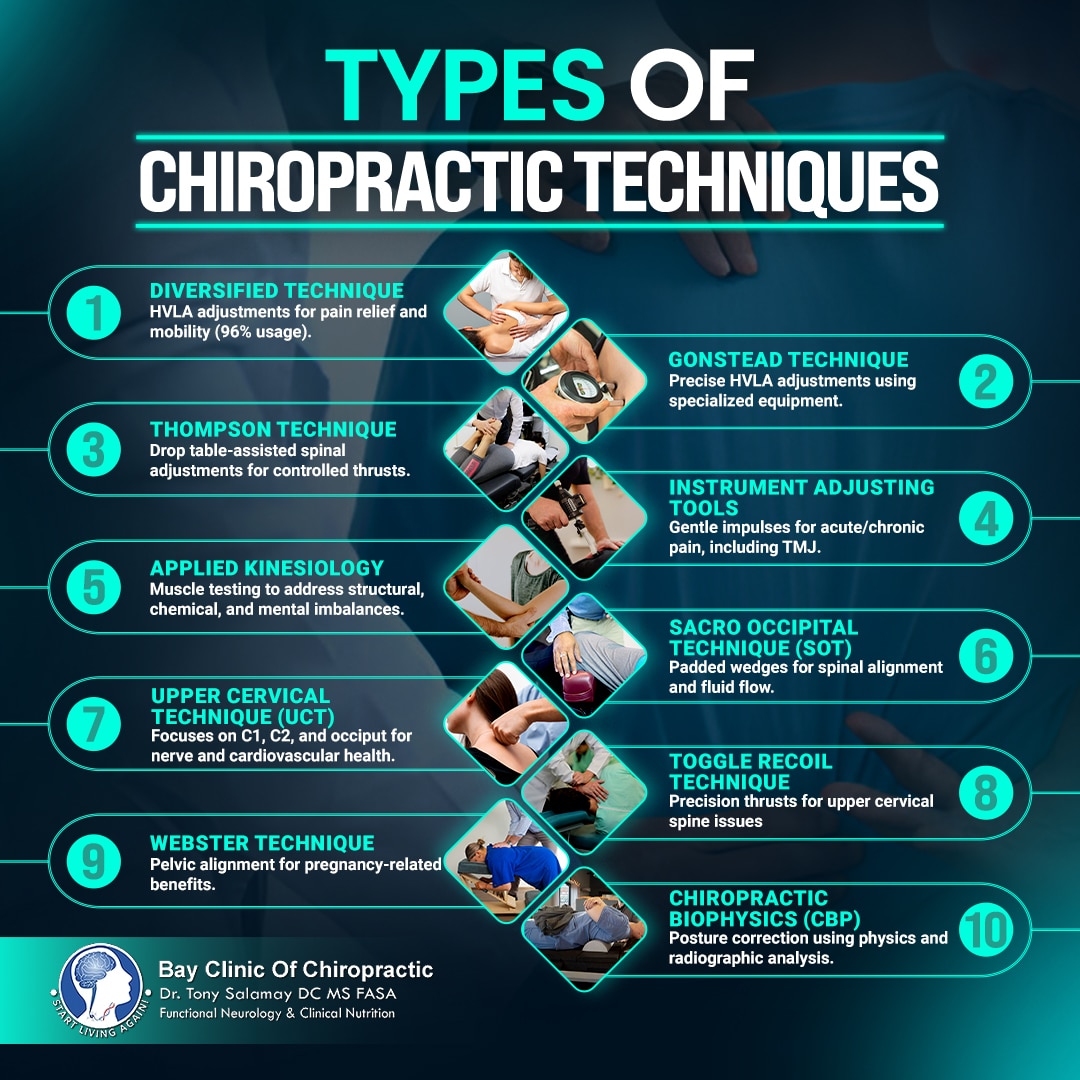
There are more than 130 types of chiropractic techniques, with the most common ones being the Diversified technique, Gonstead technique, Thompson technique, instrument adjusting tools, and applied kinesiology. Most chiropractic techniques revolve around making adjustments to the spine, although some can also be applied to other areas of the body.
These techniques are among the most commonly taught in chiropractic schools. We consider them below.
Diversified Chiropractic Technique
The Diversified Technique is a high-velocity, low-amplitude (HVLA) technique that uses high-speed, low-amplitude (short distance) motions to adjust different joints, particularly in the spine. The Diversified technique is so named because it combines the desirable features and properties of other chiropractic manipulation techniques.
Diversified Technique is – by a pretty significant margin – the most common chiropractic technique, and it is used in up to 96% of cases. The Diversified technique is a type of high-velocity, low-amplitude (HVLA) technique. HVLA techniques involve a quick use of force over a short duration, distance, and/or rotational area within a joint’s range of motion. Put another way, HVLA techniques involve the use of short, rapid thrusts (movements) to manipulate the joint.
The primary goal of HVLA techniques is improving a joint’s range of motion and relieving pain. Diversified is often accompanied by a popping sound, and it is an effective chiropractic treatment for patients of all ages and medical histories. The chiropractor may put the patient in different positions to maximize the spinal realignment.
Gonstead Chiropractic Technique
The Gonstead Technique is an HVLA technique, meaning it also uses high-speed, low-amplitude thrust motions to realign the target joint. Also known as the Palmer Gonstead Technique (named after its founder), the Gonstead Technique may be associated with a popping sound. More than 58% of all cases in chiropractic clinics involve the use of this technique.
The Gonstead Technique offers more precise and targeted joint adjustments than the Diversified technique. The more precise and targeted joint adjustments limit the versatility of the Gonstead method and how many different conditions it can treat. However, the Gonstead method makes up for this shortcoming by offering benefits for conditions that other chiropractic techniques may not be so specialized for.
The Gonstead Technique also differs from Diversified in terms of the patient’s positioning. The Diversified Technique can be done with the patient face-down, face-up, or on their side. Conversely, Gonstead is done with the patient on their side or sitting on specially built tables or chairs, like the cervical chair.
Thompson Chiropractic Technique
The Thompson chiropractic technique is an HVLA technique that uses a special table that can drop while chiropractors apply a high-velocity, low-amplitude thrust motion. There is a preload force in this technique, usually followed by a large thrusting force. The table dropping is to reduce the pain symptoms of the condition as it translates to a better feel of the vibrations of the adjustments.
Frequently known as the Drop Table technique or the Thompson Terminal Point, the Thompson technique also improves the range of motion through the falling motion of the table. The A cracking sound may accompany the Thompson technique, and chiropractors use the technique almost solely for spinal adjustments. The motions involved in the Thompson method may be done multiple times for better results, depending really on what the chiropractor thinks.
Instrument Adjusting Tools
Instrument adjusting tools do not involve the use of high-velocity, low-amplitude thrust motions. Instead, the instrument adjusting method uses a spring-loaded, handheld instrument that provides a gentle impulse to the spine, neck bones, sacrum, and pelvis for realignment purposes. Instrument adjusting is the second most common chiropractic technique and for a good reason.
Also known as the Activator Technique, with the instrument known as an Activator Adjusting Instrument, instrument adjusting tools are only a part of the chiropractic technique. Usually, there is an extensive assessment of the joint dysfunction, making instrument adjusting a broad chiropractic technique. The Activator Technique is as beneficial as HVLA techniques for acute and chronic spinal pains, and temporomandibular joint (TMJ) disorders.
Applied Kinesiology Chiropractic Technique
Applied Kinesiology is a chiropractic approach based on the study of muscles and movement as a diagnostic and treatment mechanism. Applied kinesiology emphasizes that imbalances in the chemical, mental, and structural aspects of the human body can lead to health issues. Also known as the muscle testing method, applied kinesiology enables practitioners to assess these imbalances and recommend targeted therapies to restore overall health.
Chiropractors utilize various other techniques and therapies for applied kinesiology. These techniques include specific joint manipulation or mobilization, myofascial release, cranial technique, clinical nutrition, and several other reflex methods.
Sacro Occipital Technique (SOT)
The Sacro Occipital Technique (SOT) is a gentle chiropractic technique that leverages the relationship between the sacrum (the base of the spine) and the occiput (the base of the skull) to correct misalignments in the spine and treat nervous system problems.
There are three categories to the SOT treatment. Category 1 refers to problems with the cranial sacral system and the system’s distribution of cerebrospinal fluid (CSF). Cerebrospinal fluid is a clear, colorless liquid that flows in and around the brain and spinal cord, serving as a cushion to protect the brain and spinal cord from injury.
Category 2 is associated with sprains in the pelvis ligaments, causing a loss of stability and balance, as well as affecting the body’s weight-bearing ability. Category 3 relates to problems with the discs between the vertebrae of the spine. The discs of the spine act as a shock absorber when we move to prevent the spine vertebrae from clattering into themselves.
SOT typically involves the use of padded wedges, known as blocks, positioned under the pelvis. These SOT blocks serve as fulcrums, allowing the chiropractor to correct misalignments in the affected areas, depending on whether the individual’s sacro-occipital problem is Category 1, 2, or 3.
Upper Cervical Technique
Upper cervical technique (UCT) is a chiropractic technique that focuses on the upper cervical region of the spine, particularly the occiput (the base of the skull), C1 (atlas), and C2 (axis). The C1 and C2 vertebrae are the first two vertebrae at the top of the cervical spine. UCT also focuses on the intervening tendons and ligaments of the cervical spine.
The UCT is an important chiropractic technique considering the wide range of body functions that the upper cervical region of the spine controls. These body functions include proper nervous system function, brainstem protection, heart rate, blood pressure, breathing, and communication between the brain and the rest of the body.
UCT itself is not a single technique; instead, UCT comprises multiple chiropractic techniques that target the upper cervical spine. Some of the common UCT techniques are the Blair technique, Knee Chest Upper Cervical, Toggle recoil, Grostic, National Upper Cervical Chiropractic Association (NUCCA), Atlas Orthogonal, and Orthospinology.
UCT techniques can help manage neck pain, cardiovascular problems, headaches, and structural neck issues. A chiropractor examines the patient and then determines the exact UCT technique that will benefit the patient.
Toggle Recoil Technique
The toggle recoil technique is a specialized upper cervical technique that targets the C1 and C2 (the top two vertebrae of the spine). Chiropractors often require the patients to lie on their sides while performing the toggle recoil technique before applying a controlled thrust to the upper cervical spine. The chiropractor quickly releases their hand from the contact point after the application of the controlled thrust.
The key to this technique working is the controlled thrust, as too much force may cause an excessive displacement of the upper cervical region. Conversely, too little thrust will not offer any benefits to the patient. Therefore, the skill and experience of the chiropractor are key for the toggle recoil technique to be successful (as with other chiropractic techniques, really!). You can contact the Bay Clinic of Chiropractic if you want the highest level of quality mixed with experience for your chiropractic needs at (850) 785-9372 or through email at info@thebaydoctor.com.
A study in the Journal of Manipulative and Physiological Therapeutics found that the toggle recoil technique can help improve the range of motion of the cervical spine. Therefore, people with stiffness and pain in their necks and backs will benefit a lot from toggle recoil. Also, the toggle recoil adjustment can assist in the management of nervous system problems, as the upper cervical spine is related to nervous function.
Webster Technique
The Webster technique is a chiropractic technique that aims to reduce the effects of joint subluxation (partial dislocation of the joint) or sacroiliac joint (the joint that links the pelvis and the lower spine) problems. The Webster technique adjusts misaligned pelvic bones, restoring proper neuro-biomechanical function.
The most typical use of the Webster technique is for pregnant women who have intrauterine constraint, a common cause for many structural defects in the baby. An intrauterine constraint refers to a condition where a fetus cannot move freely (especially their head) due to the uterus (womb) being in a compromised position in the pelvis.
The pregnant woman can also experience a wide range of symptoms, including back pain, sciatica (characterized by sharp pain, weakness, numbness, and tingling in the buttocks and legs), swollen ankles, and sleep problems. Most women with intrauterine constraint have difficult labor and need a caesarean section for their delivery.
The Webster technique can help realign the Pelvic joints and relieve tension on the muscles and ligaments of the pelvis. The tension relief on the pelvis allows the baby to move more freely in the uterus, as well as making up for easier deliveries for the mother. If you are in the beautiful journey of pregnancy. Find out how our prenatal chiropractor can help you easy the pelvis tension.
Chiropractic Biophysics
Chiropractic Biophysics (CBP) combines physics, mathematics, and geometry principles into the management of spine disorders that cause pain, loss of range of motion, and discomfort. Chiropractors usually combine CBP with Mirror image analyses, which highlight postural positions and movements.
Poor posture is one of the most common causes of spinal pain and discomfort. Chiropractors often apply different spinal manipulation techniques to improve the spine and the patient’s health. However, Chiropractic Biophysics introduces a mathematical component to chiropractic treatment that other spinal manipulations do not consider.
The mathematical component of CBP includes identifying posture rotations with Mirror images and radiographic assessment of the spine before making a treatment decision. A 2023 study published in Cureus Journal of Medical Science showed that Chiropractic Biophysics can help improve spinal balance, reduce spinal abnormalities, and relieve pain. CBP also has the advantage of being economical in the treatment of spinal disorders.
How Does a Chiropractor Choose the Right Technique?

Chiropractors choose the right chiropractic technique by first examining the patient’s profile and medical history, assessing the type of condition, and considering their education levels in the various suitable techniques for the condition. Typically, a chiropractor chooses the technique where they have the most experience and expertise.
It is logical to wonder how chiropractors know what the right technique for a particular condition is considering the variety of options at their disposal. The decision of the right technique gets even more tricky when you factor in the fact that a condition can be managed using several different techniques. So, how do chiropractors know the right technique?
Chiropractors usually start by considering the patient’s profile, the particular case before them, and previous medical information or history. Keep in mind that chiropractic as a healthcare model emphasizes the treatment of health conditions on a case-to-case basis. Therefore, chiropractors consider the peculiarities of a particular condition and the uniqueness of the individual before deciding on the right treatment plan.
Also, some chiropractors prefer to use techniques that form their brand. Basically, this means the chiropractor may choose a technique that their chiropractic service is best associated with for the management of different health conditions.
Ultimately, though, the most important factor affecting a chiropractor’s choice of technique is their education and experience. More educated and experienced chiropractors will have a working knowledge of several chiropractic techniques. Chiropractor knowledge and experience allow chiropractors to make the most informed decision about the chiropractic technique that will best address the patient’s health concerns.
Therefore, your choice of chiropractor should also be informed by the expertise and experience of the chiropractor in different techniques. If you are looking for the best across these two factors, you are looking for The Bay Clinic of Chiropractic.
Dr. Tony Salamay is our lead chiropractor in Panama City, FL, and he has decades of experience managing different musculoskeletal conditions, as well as a working knowledge of various chiropractic techniques. We offer all of the chiropractic techniques listed here and more, choosing the right one that will guarantee the holistic healing of patients. You don’t just have to take our word for it, though – tons of reviews testify to the excellent chiropractic services we have provided patients over the last few decades.
What Is the Problem With Conventional Medicine?
The problem with conventional medicine is its relative safety and efficacy for certain conditions. Conventional medicine emphasizes the use of medications when managing health conditions, and these medications may present different safety concerns due to their side effects. Also, some conditions are simply unresponsive to medications.
Pain is one of the biggest health problems adults face in society today. Pain may occur in several different forms and may affect different parts of the body, from the head down to the toe. There have even been campaigns to make pain among the vital signs of health. The default management for pain in conventional medicine is analgesics (pain medications).
Analgesics include non-steroidal anti-inflammatory drugs (NSAIDs – ibuprofen, diclofenac, aspirin), acetaminophen (paracetamol), and opioids (morphine, codeine). Many even turn to other drug classes like steroids, antidepressants, and antiepileptics if NSAIDs and acetaminophen don’t work.
There’s a problem, though. All of these medications are associated with their side effects. Medications for chronic conditions can significantly damage vital body organs when used for an extended period. For instance, NSAIDs can lead to severe gastrointestinal bleeding; paracetamol can lead to liver or kidney damage, as well as cardiovascular problems; opioids can cause mental problems, gastrointestinal disturbances, and also tolerance problems.
Conventional medicine also frequently fails to deliver holistic healing to patients. Holistic healing is a type of healing that focuses on addressing conditions from their roots, and ensuring that the patient truly recovers from the condition and not just its symptoms.
What Are the Benefits of Chiropractic Treatments?
The main benefits of chiropractic treatments are high safety levels and efficacy in treatments. Chiropractic treatments are natural treatments, which correlates fewer side effects and, by implication, less safety concerns. Chiropractic is also effective in the treatment of different health conditions, including chronic conditions.

The safety and efficacy of chiropractic are considered in more detail below.
Safety of Chiropractic
Safety problems are not nearly as significant when using chiropractic compared to conventional medicine. Chiropractic is a natural treatment model, so its improved safety makes sense. Science backs up this claim, so you know it’s not just us talking.
Case in point – studies by the Institute of Molecular Medicine, Lisbon, Portugal on the adverse events of chiropractic manipulations showed that there are fewer than 2 serious adverse events per 10,000,000 (ten million!) manipulations. While regular adverse events may occur more frequently, they are often benign (mild) and transitory (lasting a short while).
Efficacy of Chiropractic Techniques
Chiropractic manipulation techniques are useful treatment options for the management of spine, neck, back, shoulder, and knee pain, especially those of a chronic nature. Since the safety aspect of chiropractic techniques is not a problem, the next logical question is the efficacy aspect. Do they work? The answer is yes.
Chiropractic treatment gives results similar to or even better than conventional medicine options in some cases. Matter of fact, these conservative techniques are even the preferable options for the management of many musculoskeletal problems, including back pain, knee pain, and hip pain.
The safety and efficacy of chiropractic techniques have been proven. However, these chiropractic techniques are also just a part of healthcare and not the whole of healthcare. Therefore, you should not neglect your healthcare provider’s advice and recommendations, especially if you have underlying health conditions or are established on a medication regimen.
Frequently Asked Questions
What Is the Best Chiropractic Technique?
There is no single chiropractic technique that can be regarded as the best, as the choice of a technique is typically heavily dependent on the particular case and patient profile. However, there is a very clear answer for the most commonly used chiropractic technique – the Diversified technique. The Diversified technique is also the most commonly taught at chiropractic schools and centers.
What Are Muscle Strain Chiropractic Treatment Techniques?
Muscle strain chiropractic treatment techniques include soft tissue massage, targeted exercise, electrical muscle stimulation, and some types of spinal manipulation. The exact technique used depends on the presentation of the condition and other patient characteristics. Additionally, it is not unusual for chiropractors to advise on home treatment strategies for quick recovery.
What Are the Suitable Chiropractic Techniques for TMJ?
Chiropractic techniques suitable for TMJ include spinal adjustments to realign the jaw and cervical spine, myofascial release to alleviate muscle tension, and craniosacral therapy to enhance nervous system function. Also, soft tissue mobilization and exercises to strengthen jaw muscles and improve mobility can be beneficial. Chiropractic techniques aim to relieve pain and restore function to the jaw, as well as promote overall balance in the musculoskeletal system.
How Do Chiropractors Choose the Right Technique?
Chiropractors choose the right technique based on the patient’s condition, medical history, and their own expertise and experience. Chiropractic is a patient-centered healthcare model, so chiropractors make sure to consider the patient’s symptoms, needs, and preferences when trying to choose a suitable technique. Ideally, the chosen technique should align with the unique needs of the individual for effective and safe treatment.
What Are the Benefits of Chiropractic Over Conventional Medicine?
Chiropractic techniques are generally safer than medications, especially for chronic conditions that last extended periods because there are fewer side effects to the treatment. The chiropractic healthcare model also focuses on treating the root cause of a condition, rather than simply addressing its symptoms. Chiropractic is just as effective as medications for many chronic pain conditions.
What Should I Consider When Choosing a Chiropractor?
When choosing a chiropractor, consider their experience, qualifications, expertise in different chiropractic techniques, and reviews from previous patients. Finding a chiropractor with a strong track record in treating conditions similar to yours is important. You should also be on the lookout for a chiropractor who personalizes treatment and is willing to listen to you about your symptoms and the various factors that may be affecting your condition.
Conclusion
Chiropractic techniques are how chiropractic enhances musculoskeletal health and overall well-being. From the widely practiced Diversified and Gonstead techniques to the gentle methods of Applied Kinesiology, each technique has its unique benefits. There are several different choices available for each case, and holistic healing of the condition often depends on choosing the right technique. The safety and efficacy of these techniques contribute heavily to the choice of technique.
You do not need to bear the burden of choosing the right chiropractic technique, though. The right chiropractor will have enough expertise, experience, and knowledge of these techniques to arrive at the right choice for you. Do not hesitate to reach out to us at The Bay Clinic of Chiropractic if you want the right chiropractor for you. Our lead chiropractor, Dr. Tony Salameh, has decades of experience managing different conditions. He will consider your symptoms, try to identify the root cause, and draft a personalized treatment plan that will help relieve your symptoms, as well as ensure long-term healing. You can reach us at (850) 785-9372 or through our email info@thebaydoctor.com.
References
- İlter SE, Gökçe A. Assessment of chiropractic intervention influence on pain and life quality in cervicogenic headache afflicted office workers: a review. Eur Res J. 2023;9(6):1493–1501. doi:10.18621/eurj.1324556. Available from: https://dergipark.org.tr/en/download/article-file/3251907
- National Center for Complementary and Integrative Health (NCCIH). Chiropractic in depth [Internet]. NCCIH; [cited 2025 Oct 2]. Available from: https://www.nccih.nih.gov/health/chiropractic-in-depth
- Salehi A, Hashemi N, Imanieh MH, Saber M. Chiropractic: Is it Efficient in Treatment of Diseases? Review of Systematic Reviews [Internet]. 2015. Available from: https://pmc.ncbi.nlm.nih.gov/articles/PMC4591574/
- Gleberzon BJ, Cooperstein R, Good C, Roecker C, Blum C. Developing a standardized curriculum for teaching chiropractic technique: Journal of Chiropractic Education [Internet]. 2021 Apr 5;35(2):249–57. Available from: https://pmc.ncbi.nlm.nih.gov/articles/PMC8528435/
- Elder B, Tishkowski K. Osteopathic manipulative treatment: HVLA procedure – Cervical vertebrae [Internet]. StatPearls – NCBI Bookshelf. 2022. Available from: https://www.ncbi.nlm.nih.gov/books/NBK565847/
- LaPelusa A, Bordoni B. High-Velocity Low-Amplitude manipulation techniques [Internet]. StatPearls – NCBI Bookshelf. 2023. Available from: https://www.ncbi.nlm.nih.gov/books/NBK574527/
- Huggins T, Boras AL, Gleberzon BJ, Popescu M, Bahry LA. Clinical effectiveness of the activator adjusting instrument in the management of musculoskeletal disorders: a systematic review of the literature [Internet]. 2012. Available from: https://pmc.ncbi.nlm.nih.gov/articles/PMC3280118/
- Cooperstein R. Technique system overview: Sacro Occipital Technique. ResearchGate [Internet]. 1996 Jan 1; Available from: https://www.researchgate.net/publication/272169132_Technique_system_overview_Sacro_Occipital_Technique
- Woodfield HC III, York C, Rochester RP, Bales S, Beebe M, Salminen B, et al. Craniocervical chiropractic procedures – a précis of upper cervical chiropractic [Internet]. 2015. Available from: https://pmc.ncbi.nlm.nih.gov/articles/PMC4486989/
- Herman CA, Rallings A. Resolution of Cervicalgia following Blair Upper Cervical Technique: A Case Study & Review of the literature. ResearchGate [Internet]. 2017 Dec 21; Available from: https://www.researchgate.net/publication/322071204_Resolution_of_Cervicalgia_Following_Blair_Upper_Cervical_Technique_A_Case_Study_Review_of_the_Literature
- Graham BA, Clausen P, Bolton PS. A descriptive study of the force and displacement profiles of the toggle-recoil spinal manipulative procedure (adjustment) as performed by chiropractors. Manual Therapy [Internet]. 2009 Aug 13;15(1):74–9. Available from: https://www.sciencedirect.com/science/article/abs/pii/S1356689X09001258
- Whittingham W, Nilsson N. Active range of motion in the cervical spine increases after spinal manipulation (toggle recoil). Journal of Manipulative and Physiological Therapeutics [Internet]. 2001 Nov 1;24(9):552–5. Available from: https://www.sciencedirect.com/science/article/abs/pii/S0161475401251343
- Ohm J, Alcantara J. The Webster Technique: Definition, Application and Implications. Int J Chiropr Pediatr [Internet]. [cited 2025 Oct 2]. Available from: https://icpa4kids.com/media/1160/webster_technique.pdf
- Pistolese RA. The Webster Technique: A chiropractic technique with obstetric implications. Journal of Manipulative and Physiological Therapeutics [Internet]. 2002 Jul 1;25(6):1–9. Available from: https://www.sciencedirect.com/science/article/abs/pii/S0161475402000155
- Haas JW, Woodham T, Oakley PA, Fortner MO, Harrison D. The subjective and objective improvement using Chiropractic Biophysics® protocols. Cureus [Internet]. 2023 Dec 14; Available from: https://pmc.ncbi.nlm.nih.gov/articles/PMC10723807/
- Beliveau PJH, Wong JJ, Sutton DA, Simon NB, Bussières AE, Mior SA, et al. The chiropractic profession: a scoping review of utilization rates, reasons for seeking care, patient profiles, and care provided. Chiropractic & Manual Therapies [Internet]. 2017 Nov 14;25(1). Available from: https://pmc.ncbi.nlm.nih.gov/articles/PMC5698931/
- Dubuc É, Pagé I, Boucher PB, Brousseau D, Robidoux S, Blanchette MA. Chiropractic techniques and treatment modalities included in academic programs: A survey of chiropractic educational institutions. Journal of Chiropractic Education [Internet]. 2022 Apr 28;36(2):84–92. Available from: https://pmc.ncbi.nlm.nih.gov/articles/PMC9536225/
- Martel MO, Finan PH, Dolman AJ, Subramanian S, Edwards RR, Wasan AD, et al. Self-reports of medication side effects and pain-related activity interference in patients with chronic pain. Pain [Internet]. 2015 Mar 18;156(6):1092–100. Available from: https://pmc.ncbi.nlm.nih.gov/articles/PMC4431924/
- Wu CL, Hung YL, Wang YR, Huang HM, Chang CH, Wu CC, et al. Pain prevalence in hospitalized patients at a tertiary academic medical center: Exploring severe persistent pain. PLoS ONE [Internet]. 2020 Dec 7;15(12):e0243574. Available from: https://pmc.ncbi.nlm.nih.gov/articles/PMC7721481/
- Wongrakpanich S, Wongrakpanich A, Melhado K, Rangaswami J. A Comprehensive review of Non-Steroidal Anti-Inflammatory Drug Use in the Elderly. Aging and Disease [Internet]. 2018 Jan 1;9(1):143. Available from: https://pmc.ncbi.nlm.nih.gov/articles/PMC5772852/
- McCrae JC, Morrison EE, MacIntyre IM, Dear JW, Webb DJ. Long‐term adverse effects of paracetamol – a review. British Journal of Clinical Pharmacology [Internet]. 2018 Jun 4;84(10):2218–30. Available from: https://pmc.ncbi.nlm.nih.gov/articles/PMC6138494/
- Opioid complications and side effects [Internet]. PubMed. 2008. Available from: https://www.painphysicianjournal.com/linkout?issn=1533-3159&vol=11&page=S105
- Gordon JS. Holistic Medicine: Advances and shortcomings [Internet]. 1982. Available from: https://pmc.ncbi.nlm.nih.gov/articles/PMC1273970/
- Gouveia LO, Castanho P, Ferreira JJ. Safety of chiropractic interventions. Spine [Internet]. 2009 May 1;34(11):E405–13. Available from: https://journals.lww.com/spinejournal/abstract/2009/05150/safety_of_chiropractic_interventions__a_systematic.26.aspx
- Gevers-Montoro C, Provencher B, Descarreaux M, De Mues AO, Piché M. Clinical effectiveness and efficacy of chiropractic spinal manipulation for spine pain. Frontiers in Pain Research [Internet]. 2021 Oct 25;2. Available from: https://pmc.ncbi.nlm.nih.gov/articles/PMC8915715/