Imagine we showed you pictures of two different people, one 80 years old and the other 30 years old, and asked you to identify who is 80 and who is 30. You would almost certainly be able to tell them apart because of clear appearance differences. Aging affects the skin and physical appearance; likewise, it affects the various body organs and systems, including the musculoskeletal system.
The spine is a major part of the musculoskeletal system, and as we age, the spinal discs will start to degenerate. However, the spinal degeneration in some individuals is far greater than normal, and symptoms like significant back and neck pain may follow. If this sounds like you, you may have degenerative disc disease (DDD).
Degenerative disc disease is a spinal condition where the spinal discs undergo wear and tear over time, often leading to discomfort and pain. Everyone experiences some amount of spinal degeneration with age, but not everyone has degenerative disc disease. However, the condition is still widespread, affecting up to 27% of adults.
The primary symptom of degenerative disc disorder is pain, which can be localized in the back or neck or can radiate down the limbs. Aging is the most significant cause of degenerative disc disease. Some of the other factors that contribute to the degeneration of the spine and the possible development of degenerative disc disease are injuries, obesity, smoking, poor nutrition, and metabolic disorders.
Degenerative disc disease responds very well to conservative and natural treatment options. Typical natural treatment options include chiropractic care, physical therapy, and specific lifestyle adjustments. The benefits of these natural treatments may also last for long periods, eliminating the need for more invasive procedures for most people.
Keep reading to discover the symptoms, causes, risk factors, and natural ways to manage degenerative disc disease.
What Is Degenerative Disc Disease?
Degenerative disc disease occurs when the spinal discs weaken due to wear and tear or spinal injury. The overall prevalence of degenerative disc disease is 27%, which translates to almost 1 in 3 people. Despite the name, degenerative disc disease is not an actual disease condition, but it may lead to different uncomfortable symptoms in some individuals.
The spinal discs are gel-filled, rubbery, round discs between the vertebrae that act as shock absorbers when we move. Without the spinal discs, the vertebrae will clatter into themselves when we move, resulting in quick wear out of these bones and disability. Therefore, the spinal discs are essential in the spine’s architecture.
The spinal discs wear out as we age and experience some degeneration, which may result in degenerative disc disease. Not everyone will experience degenerative disc disease, even though everyone will have spinal degeneration with age. Degenerative disc disease can occur in the neck (cervical), chest (thoracic), and lumbar (lower back) regions of the spine.
What Are the Symptoms of Degenerative Disc Disease?
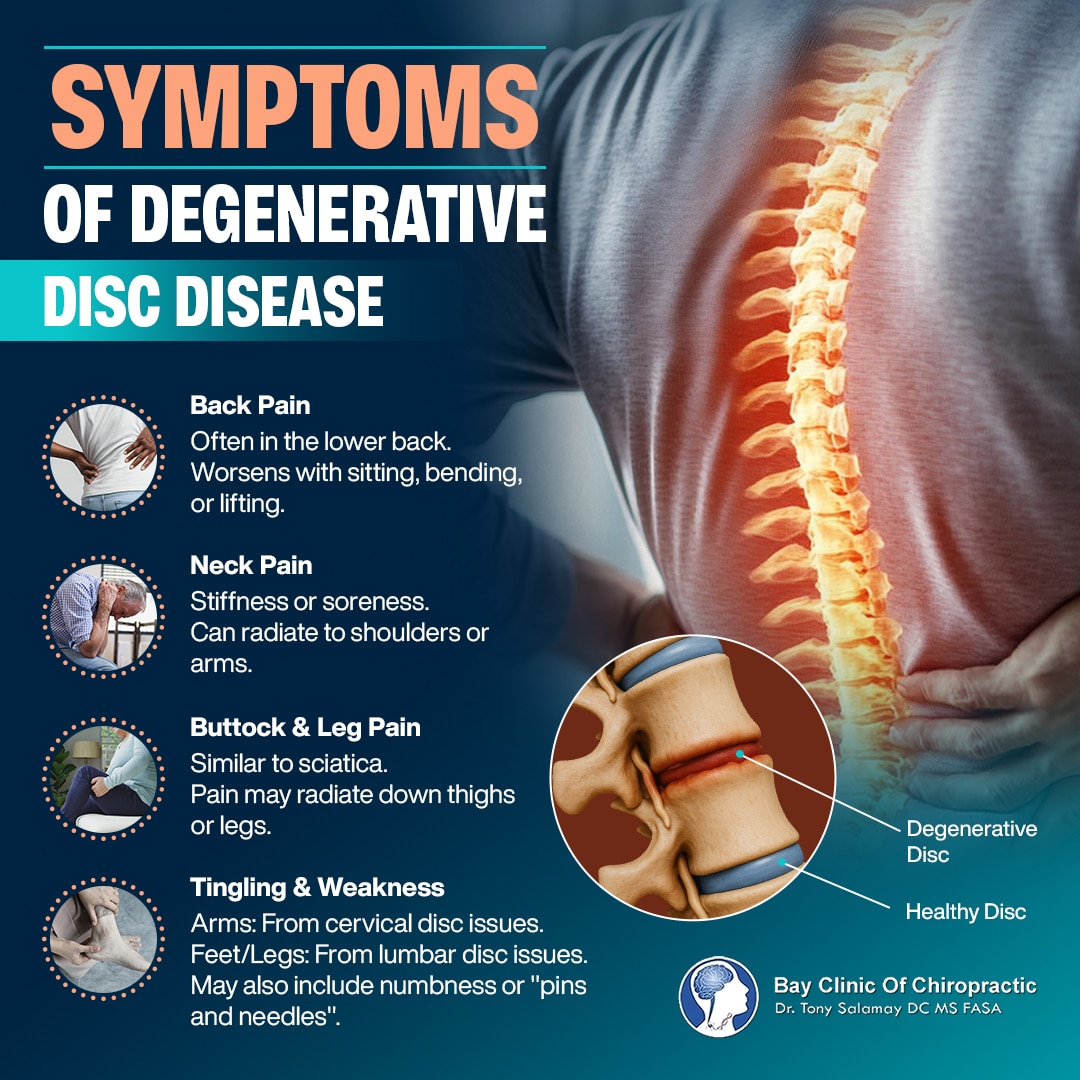
The main symptoms of degenerative disc disease are back and neck pain. The back pain is usually low back pain, and degenerative disc disease accounts for 4 in 10 low back pain cases. Carrying out activities that flex (bend) the spine, like bending and lifting heavy loads, can increase the intensity of the pain.
People with degenerative disc disease experience low back pain due to reduced intervertebral disc height, which promotes the degeneration of surrounding spinal structures like ligaments, joints, and muscles. The spinal canal eventually narrows, causing spinal stenosis, which may pinch the spinal nerves and cause lower back pain.
The low back pain may also radiate to the buttocks and legs. Other possible symptoms are neck pain, as well as tingling and weakness in the arms and feet.
What Are the Causes of Degenerative Disc Disease?
Degenerative disc disease develops due to age-related wear and tear of the spinal discs and can also result from injuries such as sports trauma or car accidents injuries.. Everyone will have some degeneration in their spine as they age, and this is typically no cause for concern. However, in some individuals, the wear and tear may cause the spinal disc to dry out or crack, which can then cause pain and other symptoms of degenerative disc disease.
Wear and tear is the most significant cause of degenerative disc disease. Wear and tear mostly affects proteoglycans (which provide structural support to the disc) in disc tissues, consequently reducing pressure within the disc matrix and causing water loss.
Losing water causes the discs to bulge and lose height, affecting many functional processes and increasing the susceptibility to pain and injury. Injuries to the spinal disc can also lead to degenerative disc disease.
What Are the Risk Factors for Degenerative Disc Disease?
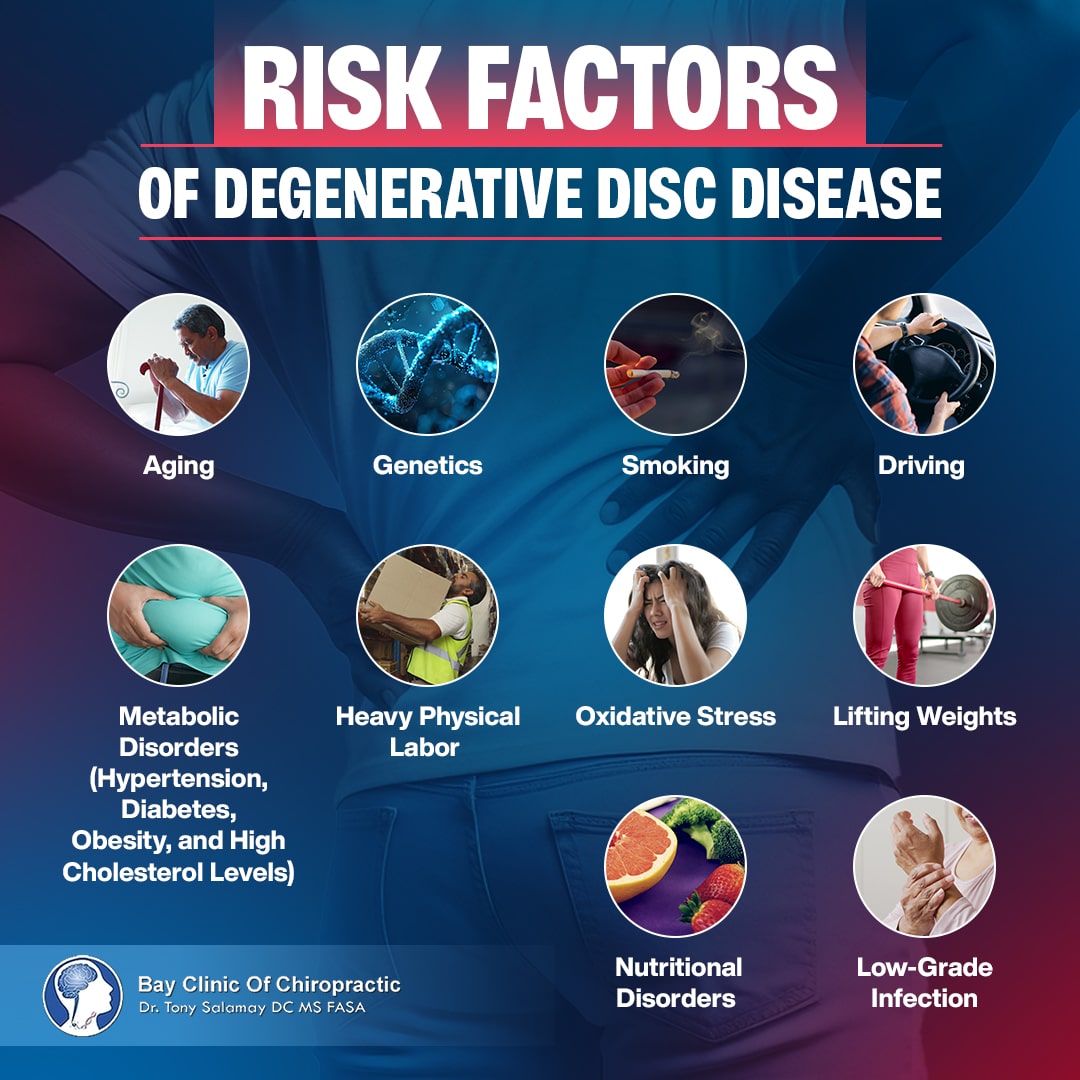
The most significant risk factor for degenerative disc disease is age. Other risk factors include obesity, smoking, stress, metabolic conditions, and infections.
Here are some factors that can increase the risk of having degenerative disc disease, and they include:
- Aging. Around 1 in 10 adults over the age of 50 will have degenerative disc disease, with that number standing at 5 in 10 for adults over the age of 70.
- Genetics, as some individuals have susceptible genes that lead to disc degeneration, especially on the proteins in the intervertebral discs and cartilage
- Metabolic disorders, which are conditions that can affect the normal metabolism of energy in the body, like hypertension, diabetes, obesity, and high cholesterol levels, are linked with a higher risk of degenerative disc disease
- Low-grade infection, usually with low-virulence anaerobic bacteria like P. acnes (which can also cause prostate cancer and endocarditis), may play a role in the development of degenerative disc disease
- Nutritional disorders. The spinal discs also need sufficient nutritional supply to function properly, and a fall in adequate nutrition can result in cell death, loss of matrix production, and increased matrix degeneration.
- Other factors like oxidative stress, smoking, driving, lifting weights, and heavy physical labor are also potential risk factors for degenerative disc disease.
Natural Treatment Options for Degenerative Disc Disease
Natural treatment options for degenerative disc disease include chiropractic, physical therapy, and lifestyle changes. These options fall under the category of conservative treatment, which is often the first line of treatment in the management of degenerative disc disease and other sources of back and musculoskeletal pain.
Below are some typical natural treatment options for managing degenerative disc disease.
Chiropractic
Chiropractic is a branch of complementary and alternative medicine that prevents, diagnoses, and treats neuromusculoskeletal disorders. Chiropractic generally focuses on achieving holistic healing by addressing a condition from its root cause.
The benefits of chiropractic in short-term relief of back pain are well-documented, with a study in the British Medical Journal even finding that chiropractic can provide better relief than common treatments. However, chiropractic also seeks to provide long-term symptomatic relief to patients with degenerative disc disease. Chiropractors ensure this by first getting an accurate diagnosis of the condition.
The diagnosis of degenerative disc disease is usually made using a combination of the patient’s medical and family history, physical examination of symptoms, and imaging tests. Magnetic Resonance Imaging (MRI) tests are often the go-to imaging tests for diagnosing degenerative disc disease, although X-rays may also help.
After diagnosis, chiropractors try to find the root cause of the condition. The broad cause of degenerative disc disease is age-related wear and tear. However, more specific issues may be responsible for the symptoms, like cracks, drying out of the spinal discs, and disc injuries. Genetics, metabolic disorders, smoking, heavy physical labor, low-grade infection, and oxidative stress may also play a major role in the development of the condition.
No treatment option, including chiropractic, can actually address the underlying cause of degenerative disc disease and halt the degeneration of the spinal disc. However, experienced chiropractors can identify the root cause and design patient-specific treatment plans for degenerative disc disease. You can get this level of chiropractic care at The Bay Clinic of Chiropractic under the lead of Dr. Tony Salamay, an expert chiropractor in panama City, FL with decades of experience. Reach out to The Bay Clinic of Chiropractic at (850) 785-9372 or info@thebaydoctor.com.
The treatment plan that chiropractors design revolves around specific chiropractic techniques, as listed below.
Spinal Manipulation
Spinal manipulation involves the application of high-velocity, low-amplitude thrust to the end of affected joints in the spine. More than 8 in 10 chiropractic treatments revolve around spinal manipulation, and this chiropractic technique may have some use in the management of degenerative disc disease, as well.
There is little debate about the effectiveness of spinal manipulation in managing musculoskeletal conditions resulting from joint problems. However, the intervertebral discs of the spine aren’t joints, naturally causing debate about the effectiveness of spinal manipulation for disc-related issues like degenerative disc disease and disc herniation.
A 2014 study examined the potential benefits of spinal manipulation for disc herniation symptoms, and the results indicated significant improvements in the short and long term. A more recent study in 2023 also concluded that spinal manipulation may have a role to play in the management of degenerative disc disease, even though we do not have all the details about this treatment for the condition.
Activator Technique
The Activator Technique involves using instrument adjusting tools (spring-loaded, handheld instruments) to provide a gentle impulse to the spine, which can help spinal pain management. The instrument adjusting method can also be applied to the neck, sacrum, and pelvis. Applying the Activator Technique to the spine technically makes it a form of spinal manipulation, but this technique is broad enough to have its own section.
The Activator Technique can benefit patients with degenerative disc disease, causing subjective and objective improvements in low back pain symptoms. Chiropractors often consider the Activator Technique for degenerative disc disease, not just because of its effectiveness but also because improvement outcomes are long-lasting.
Physical Therapy
Physical therapy involves using exercise, physical adjustments, and physical stimuli (heat, cold, electrical currents) to treat musculoskeletal conditions. Physical therapy can help strengthen the back muscles, which can then help improve mobility and prevent pain.
However, not all physical activities are built the same, and choosing the wrong ones can actually make your condition worse. High-impact activities, like intense running, jumping, and heavy lifting, can stress the already-weak spine, causing even worse symptoms. Therefore, you need to talk to your healthcare provider before deciding on the right physical activities to help your condition.
Lifestyle Changes

Certain lifestyle factors can increase the risk of degenerative disc disorder, such as heavy physical labor, intense exercise, weight lifting, high-impact sports, smoking, and poor nutrition. The right lifestyle changes for the management of degenerative disc disease will involve modifications to some of the risk factors of the condition.
Some of the lifestyle changes to manage degenerative disc disease include:
- Limiting heavy lifting
- Avoiding high-impact sports, especially on hard floors, like basketball, football, soccer
- Light to moderate physical activity
- Quitting smoking
- Healthy diet
Frequently Asked Questions
Will Degenerative Disc Disease Go Away on Its Own?
No, degenerative disc disease will not go away on its own and will only get worse if left untreated. Degenerative disc disease is a progressive condition, which means it gets worse with time. The rate of progression of the condition varies by individual, with factors like frequent heavy lifting and occupations that involve high-impact activities contributing to worse symptoms.
Therefore, neglecting degenerative disc disease and not getting the right treatment early can make the condition’s symptoms much worse. Other health complications may also result if degenerative disc disease is not properly managed. Some of these complications are scoliosis, herniated discs, or spinal stenosis. These complications can further worsen the individual’s quality of life and make subsequent treatments much more difficult.
Is Degenerative Disc Disease Preventable?
You can prevent degenerative disc disease to a significant extent with the right lifestyle changes, like weight management, regular physical activity, good posture, and quitting smoking. However, degenerative disc disease is an age-related condition, and it may be impossible to totally prevent it even if you make all the right lifestyle changes.
Do You Need Surgery for Degenerative Disc Disease?
No, you will typically not need surgery for degenerative disc disease, as the condition responds well to conservative treatments. Health practitioners consider surgery a last resort in the management of degenerative disc disease, only recommending it when other conservative treatments have failed and/or symptoms are severe.
People who do need surgery may be recommended spinal fusion (which connects spinal vertebrae), diskectomy (removing a portion of the spinal disc), artificial disc replacement (replacing the affected disc with a plastic or metal one), and laminectomy (removing a portion of the spine).
Can You Exercise if You Have Degenerative Disc Disease?
Yes, you can still exercise if you have degenerative disc disease, but only low-impact exercise, like walking and stretching. High-impact exercise can increase the stress on the spine, which may worsen the symptoms of degenerative disc disease.
Examples of high-impact exercise include intense running, high-intensity sports (like football, basketball, and soccer), and jumping rope. People with degenerative disc disease also have to avoid other high-impact activities like heavy lifting. Talk to your healthcare provider if you are unsure if a particular activity constitutes high-impact or high-intensity.
Is There a Cure for Degenerative Disc Disease?
No, there is no cure for degenerative disc disease, and it is a lifelong condition. However, degenerative disc disease responds very well to treatment, and the right treatment options can significantly improve the symptoms of the condition. Many experts rely on conservative treatments initially before considering surgery.
Some of the best conservative treatments that can guarantee safe and long-term healing are natural, and they include chiropractic and physical therapy. Certain lifestyle changes, like stress management, weight management, and smoking cessation, may also improve degenerative disc disease symptoms and the patient’s overall health.
Conclusion
Degenerative disc disease is a progressive condition of the spine that causes neck and back pain, as well as numbness, tingling, and weakness in the arms and legs. Everyone experiences a level of spine degeneration, but not everyone has degenerative disc disease.
Fortunately, there are effective natural treatment options that can provide safe and effective symptomatic relief for people with degenerative disc disease. These treatments include chiropractic, physical therapy, and lifestyle changes. The effectiveness of the treatment depends a lot on the quality of the health practitioner administering and recommending them.
Therefore, you should visit only quality and experienced professionals for the management of disc degenerative disease and its symptoms. If you live in and around Panama City and need the services of an experienced chiropractor, reach out to The Bay Clinic of Chiropractic at(850) 785-9372 or info@thebaydoctor.com. Dr. Tony Salamay is the lead chiropractor in the clinic and has decades of experience with musculoskeletal conditions and managing related musculoskeletal symptoms.
References
- Parenteau CS, Lau EC, Campbell IC, Courtney A. Prevalence of spine degeneration diagnosis by type, age, gender, and obesity using Medicare data. Scientific Reports [Internet]. 2021 Mar 8;11(1). Available from: https://pmc.ncbi.nlm.nih.gov/articles/PMC7940625/
- Anderson DG, Tannoury C. Molecular pathogenic factors in symptomatic disc degeneration. The Spine Journal [Internet]. 2005 Nov 1;5(6):S260–6. Available from: https://www.sciencedirect.com/science/article/abs/pii/S1529943005000896
- Boxberger JI, Orlansky AS, Sen S, Elliott DM. Reduced nucleus pulposus glycosaminoglycan content alters intervertebral disc dynamic viscoelastic mechanics. Journal of Biomechanics [Internet]. 2009 Jun 19;42(12):1941–6. Available from: https://pmc.ncbi.nlm.nih.gov/articles/PMC2756063/
- Kos N, Gradisnik L, Velnar T. A brief review of the degenerative intervertebral disc disease. Medical Archives [Internet]. 2019 Jan 1;73(6):421. Available from: https://pmc.ncbi.nlm.nih.gov/articles/PMC7007629/
- Kawaguchi Y. Genetic background of degenerative disc disease in the lumbar spine. Spine Surgery and Related Research [Internet]. 2018 Jan 1;2(2):98–112. Available from: https://pmc.ncbi.nlm.nih.gov/articles/PMC6698496/
- Fujita N, Ishihara S, Michikawa T, Azuma K, Suzuki S, Tsuji O, et al. Potential association of metabolic and musculoskeletal disorders with lumbar intervertebral disc degeneration: Cross-sectional study using medical checkup data. Journal of Orthopaedic Science [Internet]. 2019 Jun 5;25(3):384–8. Available from: https://www.sciencedirect.com/science/article/abs/pii/S0949265819301460?via%3Dihub
- Lin Y, Jiao Y, Yuan Y, Zhou Z, Zheng Y, Xiao J, et al. Propionibacterium acnes induces intervertebral disc degeneration by promoting nucleus pulposus cell apoptosis via the TLR2/JNK/mitochondrial-mediated pathway. Emerging Microbes & Infections [Internet]. 2018 Jan 10;7(1):1–8. Available from: https://pmc.ncbi.nlm.nih.gov/articles/PMC5837142/
- Tang G, Wang Z, Chen J, Zhang Z, Qian H, Chen Y. Latent infection of low-virulence anaerobic bacteria in degenerated lumbar intervertebral discs. BMC Musculoskeletal Disorders [Internet]. 2018 Dec 1;19(1). Available from: https://bmcmusculoskeletdisord.biomedcentral.com/articles/10.1186/s12891-018-2373-3
- Teraguchi M, Yoshimura N, Hashizume H, Yamada H, Oka H, Minamide A, et al. Progression, incidence, and risk factors for intervertebral disc degeneration in a longitudinal population-based cohort: the Wakayama Spine Study. Osteoarthritis and Cartilage [Internet]. 2017 Jan 13;25(7):1122–31. Available from: https://www.oarsijournal.com/article/S1063-4584%2817%2930007-9/fulltext
- Lee SW, Nguyen D, Mack D, Aguila E, Thomas M, Doddy K. Conservative management of low back pain. HCA Healthcare Journal of Medicine [Internet]. 2021 Oct 29;2(5). Available from: https://pmc.ncbi.nlm.nih.gov/articles/PMC10324732/
- Salehi A, Hashemi N, Imanieh MH, Saber M. Chiropractic: Is it Efficient in Treatment of Diseases? Review of Systematic Reviews [Internet]. 2015. Available from: https://pmc.ncbi.nlm.nih.gov/articles/PMC4591574/
- Lin AFC, Cunliffe C, Chu VK, Chan V, Leung AC, Lau RP, et al. Prevention-Focused Care: The potential role of chiropractors in Hong Kong’s primary healthcare transformation. Cureus [Internet]. 2023 Mar 31; Available from: https://pmc.ncbi.nlm.nih.gov/articles/PMC10064816/
- Breen A, Leerberg E, Pedigo MD, Waddell G, Giles LGF, Ernst E, et al. Chiropractic for low back pain. BMJ [Internet]. 1999 Jan 23;318(7178):261. Available from: https://pmc.ncbi.nlm.nih.gov/articles/PMC1114738/
- Erwin WM. Should you adjust that herniated disc? Thoughts from a chiropractor/molecular scientist [Internet]. 2023. Available from: https://pmc.ncbi.nlm.nih.gov/articles/PMC10211408/
- Kirnaz S, Capadona C, Lintz M, Kim B, Yerden R, Goldberg JL, et al. Pathomechanism and Biomechanics of Degenerative disc disease: Features of healthy and degenerated discs. The International Journal of Spine Surgery [Internet]. 2021 Apr 1;15(s1):10–25. Available from: https://www.ijssurgery.com/content/15/s1/10
- Hurwitz EL, Coulter ID, Adams AH, Genovese BJ, Shekelle PG. Use of chiropractic services from 1985 through 1991 in the United States and Canada. American Journal of Public Health [Internet]. 1998 May 1;88(5):771–6. Available from: https://pmc.ncbi.nlm.nih.gov/articles/PMC1508935/
- Leemann S, Peterson CK, Schmid C, Anklin B, Humphreys BK. Outcomes of acute and chronic patients with Magnetic Resonance Imaging–Confirmed symptomatic lumbar disc herniations receiving High-Velocity, Low-Amplitude, spinal Manipulative therapy: a Prospective Observational cohort Study with One-Year Follow-Up. Journal of Manipulative and Physiological Therapeutics [Internet]. 2014 Mar 1;37(3):155–63. Available from: https://www.jmptonline.org/article/S0161-4754%2814%2900034-7/fulltext
- Huggins T, Boras AL, Gleberzon BJ, Popescu M, Bahry LA. Clinical effectiveness of the activator adjusting instrument in the management of musculoskeletal disorders: a systematic review of the literature [Internet]. 2012. Available from: https://pmc.ncbi.nlm.nih.gov/articles/PMC3280118/
- Roberts JA, Wolfe TM. Chiropractic management of a veteran with lower back pain associated with diffuse idiopathic skeletal hypertrophy and degenerative disk disease. Journal of Chiropractic Medicine [Internet]. 2012 Nov 21;11(4):293–9. Available from: https://pmc.ncbi.nlm.nih.gov/articles/PMC3706700/
- Institute for Quality and Efficiency in Health Care (IQWiG). In brief: Physical therapy [Internet]. InformedHealth.org – NCBI Bookshelf. 2024. Available from: https://www.ncbi.nlm.nih.gov/books/NBK561514/
- NHS. Scoliosis [Internet]. NHS; [cited 2025 Oct 2]. Available from: https://www.nhs.uk/conditions/scoliosis/
- Stretanski MF, Hu Y, Mesfin FB. Disk Herniation [Internet]. StatPearls – NCBI Bookshelf. 2025. Available from: https://www.ncbi.nlm.nih.gov/books/NBK441822/
- National Institute of Arthritis and Musculoskeletal and Skin Diseases (NIAMS). Spinal stenosis [Internet]. NIAMS; [cited 2025 Oct 2]. Available from:https://www.niams.nih.gov/health-topics/spinal-stenosis